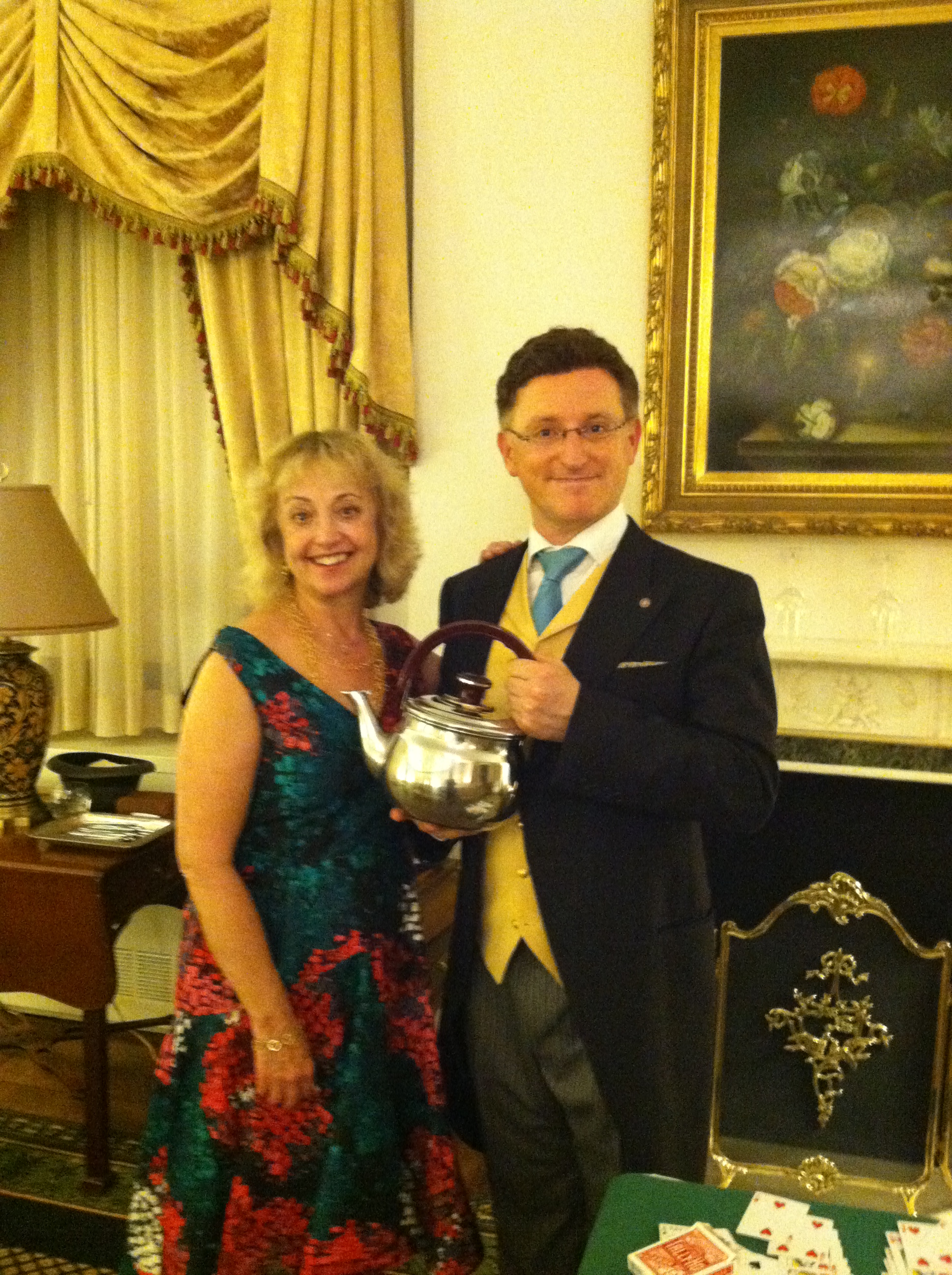
 Do you believe in magic? You might after seeing Steve Cohen’s Chamber Magic Show at Waldorf Astoria Hotel in New York City. His fame has grown since he started in 2001, but not the size of each audience, which he limits to fifty, to create an intimate, interactive experience. As befits the Waldorf, Steve performs in an elegant, custom-tailored suit – an homage to a bygone, more elegant era. Most of us dress in cocktail attire, because we’re all part of the show – and what a show! There’s sleight-of-hand (including a card that seems to turn a somersault in the air before landing in the middle of a shuffled deck), mental telepathy (Cohen guessed one audience member was thinking about his pet chinchilla), and a delightful “Think a Drink” teapot that could pour any drink his audience imagined! Steve’s setting, sartorial choices, and select audiences (stars of stage and screen, royalty, and Fortune 500 companies) have dubbed him “The Millionaires’ Magician,” but Steve prefers to think of himself as “the thinking man’s magician.” After his performance, we had a chance to chat, and I asked him why: Steve Cohen (SC): In many magic performances there’s color, flash, and light shows. This show has a lot of talking and interaction. We have people coming in here who are absolutely brilliant, MIT professors walk away shaking their heads, not because their eyes were fooled, but because I fooled their thought processes. There’s something in magic called “bubble gum for the eyes” – – you’re bombarded with images. My show very few images, but lots of unusual scenarios that you become embroiled in. Sue: How did you get started performing at the Waldorf? SC: I began at friend’s house, but his wife objected because too many strange people were coming to their home. Then I performed at the National Arts Club, which shuts down in the summer. At the last show I met Holly Peppe (now my manager) who offered to introduce me to someone at Waldorf. I’ve now done the show at Waldorf over 3000 times. Sue: What would you consider to be your best audience? SC: The best audiences for me are those who follow the rules: get dressed up and be ready to be engaged. Chamber Magic is a very interactive show, and the smarter the audience the better – especially during the mind-reading segment. Smart people have a lot on their minds, or unusual hobbies, like being a scuba diver. I can go into more in-depth detail when reading their thoughts, including details about where they’ve dived and how many feet down. Sue: Why do you think so many comics (like Johnny Carson and Dick Cavett) started as magicians? SC: There are many parallels between magic and comedy. Performers in both fields challenge their audience, and surprise them at the end. Magicians and comics both portray characters, and stick to material that suits their characters. Comics often stay away from the necessity to hide behind props, and maybe that’s why they converted from magic to comedy. Still, the presentational skills are essentially the same. Sue: As you may know, I wrote the book Queens of Comedy. I was interested in why there are comparatively few female standup comics. Why are there so few female magicians? SC: In ancient cultures, the spiritual leader of a clan or community was a female shaman. Female, because women have the magical power of creating life. There’s a great book The Chalice and the Blade that discusses this finding. Later on, as societies became dominated by males, there was a shift toward male shamans who were considered spiritual leaders. Shamans eventually transformed into the modern-day role of magicians. Sue: So it’s a reflection of the change in the power dynamics in society. SC: Yes, because a magician is supposed to wield power that ordinary mortals can’t. There aren’t many female magicians these days because of sexism. Women feel they have to go on stage wearing revealing clothing to keep the audience’s attention. They might be very skilled but they still feel they have to look a certain part. I’d like to see a woman go on stage and have people say she is a great magician without even realizing she’s female. That would show that she has a degree of expertise that is undeniably impressive. In magic most of the women who appear on stage are magician’s assistants who are portrayed as sex symbols. They dress in bikinis and get cut up, sliced and diced, appear, disappear, and get their heads get chopped off. It’s all very misogynistic but it’s the standard formula. I’ve always thought it’s pretty demeaning. I won’t have a female assistant in my show. My audience is my assistant. Everyone is equally my assistant – male or female. Sue: When did you decide to become a magician? I read that you have been doing magic since you were six years old, and your great-uncle taught you your first trick. SC: He was a really good amateur magician, who used to do magic all the time at family parties. Afterwards, he would pull me aside and teach me how to do it. He would make sure no one else was watching, then he would take out something from his pocket – a secret gimmick and say, “This is yours now, but you have to really practice.” And until he said “You’re ready” I wasn’t allowed to show it to anybody else. Sue: How did you parents react when you told them you wanted to be a professional magician? SC: They were always very supportive. Before I got my driver’s license, they used to drive me to my gigs at birthday parties in Westchester County – two or three every weekend. I would get paid, and they would drive me to the next show. Sue: Who were your role models or heroes? SC: I’ve got three magicians. One of them is Max Malini, who used to perform here at the Waldorf. He was a kind of mountebank, and he would travel the world. He went from being dirt poor to performing for kings, queens, and captains of industry like Andrew Carnegie and the Vanderbilt family. Another is Johann Hofzinser from Vienna, and I made a pilgrimage to his gravesite. He was the creator of this style of salon show, which he did for the upper crust of Viennese society. In the 1850’s- 60’s, people used to gather in salons and talk about the news of the day or philosophy. He opened up a magic salon, where they would watch him do magic. He charged the equivalent of a Broadway ticket price with dinner. Hofzinser called card tricks “the poetry of magic.” He invented hundreds, maybe thousands of card magic tricks that we still use today. The stuff that I do in my show is directly linked to Hofzinser. The last one is a French magician named Robert Houdin, who is considered to be the father of modern magic. Houdini took his name from Jean Eugene Robert-Houdin. Before him, magic was performed on the streets by a character dressed up as a wizard’s cap. Houdin took it off the streets, put it into an elegant drawing room setting, and wore clothes like I wear – evening clothes. He dressed as well as his audiences, who could choose to go to the ballet or the opera, but instead they chose to go to a magic show because it had the gravitas that he brought to it, and magic became another respected art form. Sue: Do you have a favorite story that you would like to tell about performing magic?
  SC: When I do the “Think a Drink” trick, that’s the part of the show where I most feel like Harry Potter because I never know what drinks people are going to be calling out, and it’s fun to see the combination in any order. People choose hot drinks and cold drinks. One of my favorites was when someone asked for a frozen margarita, so I poured out a frozen margarita – it came slushing out of the pot, and then right after that, the second person said, “I want a hot chocolate with mini marshmallows.” I picked up the pot with steam, poured the hot chocolate, and the mini marshmallows went blunk, blunk, blunk into the cup. The guy who was drinking said, “I can’t believe this!” Sue: If you were not a magician, what would you be? SC: I’d probably be a physicist. A magician is aware of the natural laws and tries to use theatrics to make it appear as if the natural laws are being broken. However, if you are a scientist, you’re not trying to break the natural laws; you’re just trying to observe them. I’ve always been interested in what is and isn’t impossible. If you’re a scientist, you’re trying to find not only what’s possible, but the basis for how it’s executed. There’s a lot of overlap between how a magician thinks and how a scientist thinks. I’m trying to entertain an audience with showing them impossible things. A scientist is trying to take those impossible things and make them apparent. Sue: A scientist is trying to take impossible things…? SC: Things that we don’t understand like quantum mechanics or satellites in outer space. Before we knew what they were, it was magic. Arthur C. Clarke said, “Any technology which is sufficiently advanced is indistinguishable from magic.” I’m interested in still keeping that mystery alive. Sue: Is there anything I haven’t covered that you would like to talk about? SC: What’s special about my show is that it’s completely interactive. I can’t do this show solo. I can’t go into a rehearsal space alone to practice this show. Sue: Why the dress code? SC: The Waldorf Astoria has a tradition. There’s a dress code even in the lobby. If I’m dressed in tails, and everyone else is dressed casually, there’s a disconnect. But when people get dressed up at home, and they’re thinking “I have to go to the magic show tonight, the show has already started for them when they’re still in their bedroom. By the time they get here, they’re already committed by what they’re wearing. Then they look around the room and see everyone else did the same, and it’s kind of special. People used to go to Broadway theatres dressed in their best clothing, but nowadays people go dressed super-casual, and nobody seems to care. I’d like to bring back that age of dressing up to go to the theatre, and people seem to like To learn more about Steve Cohen’s Chamber Magic Show visit: chambermagic.com See you at the Waldorf!
 Susan (“Dr. Sue”) Horowitz, Ph.D.
Book: “Queens of Comedy” (Lucille Ball, Carol Burnett, Joan Rivers, Phyllis Diller, and more!) www.smashwords.com/books/view/219367
Musical: “SssWitch”: www.ssswitch.net
www.YouTube.com/drsuecomedian https://www.youtube.com/feed/my_videos





 Susan (“Dr. Sue”) Horowitz, Ph.D.








 Like a rich gumbo (New Orleans ) or Manhattan clam chowder (New York), big cities can be spiced for every palate: from fantasy wild to family mild.
There’s no way to summarize their delights in one blog, but here’s a taster’s menu.
Red Fish Grill: “Friends don’t let friends eat frozen fish” is the motto of this Bourbon Street restaurant, which serves only fresh-caught fish in an ambiance of artworks by local artist Luis Colmenares.
Here I am displaying my catch: a metal sculpture of a fish by Colmenares.
(By the way the meal was much tastier – and easier to cut!)
Like a rich gumbo (New Orleans ) or Manhattan clam chowder (New York), big cities can be spiced for every palate: from fantasy wild to family mild.
There’s no way to summarize their delights in one blog, but here’s a taster’s menu.
Red Fish Grill: “Friends don’t let friends eat frozen fish” is the motto of this Bourbon Street restaurant, which serves only fresh-caught fish in an ambiance of artworks by local artist Luis Colmenares.
Here I am displaying my catch: a metal sculpture of a fish by Colmenares.
(By the way the meal was much tastier – and easier to cut!)